
Visitor information

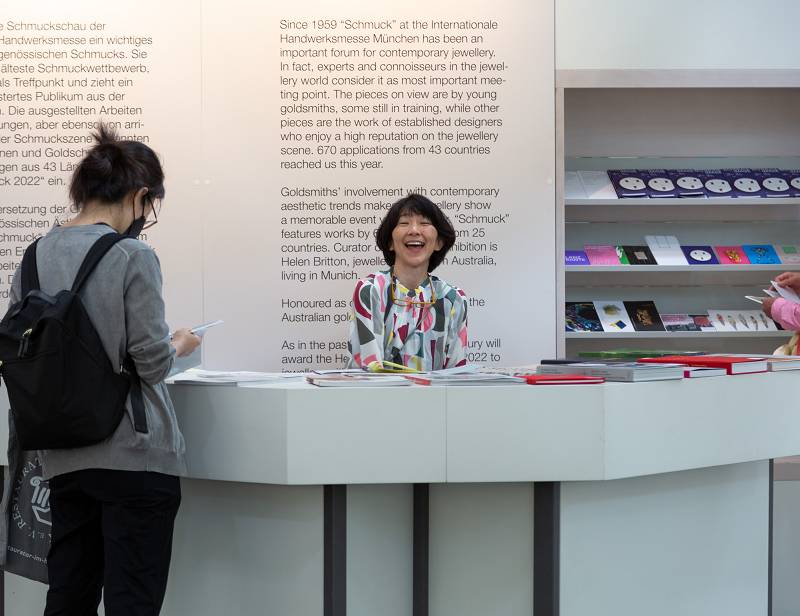
Visit the special show during the Internationale Handwerksmesse in Hall B1.
Show in Google Maps

Opening hours

Wednesday, March 4 to Sunday, March 8, 2026
09:30 – 18:00

Arrival by Underground

Underground line 2, “Messestadt West” station

You can find more information on how to get here on the Internationale Handwerksmesse website. You can also buy your tickets online there.
Sam Tho Duong, Curator 2026

Born in Vietnam and based in Pforzheim, Sam Tho Duong is one of the most influential voices in contemporary jewellery. With his experimental eye, he transforms natural finds and everyday materials into poetic, precisely designed works.

“The beginning of many works lies in observing nature and the everyday.”

Growth, decay and chance are creative motors for him:

“Failed attempts often open up new horizons.”

With international exhibitions, major prizes such as the Friedrich Becker Prize and the Herbert-Hofmann-Prize as well as works in museums such as the V&A London or MAD New York, Duong brings expertise and sensitivity to his role as curator of SCHMUCK 2026.

Find out more about the curator and his selection for SCHMUCKmünchen 2026 in a YouTube interview with Internationale Handwerksmesse.

Catalogue

Each SCHMUCK exhibition has been documented in a catalogue since 1983.

The 2026 catalogue will be available to you at the start of the trade fair.

You can purchase it at the Internationale Handwerksmesse in Hall B1 and in the Galerie Handwerk or order it online.

Modern classics

During the special exhibition, we will be presenting the artistic position of a modern classic. At SCHMUCKmünchen 2026, the life’s work of artist Erico Nagai will be honoured.

Erico Nagai, born in Tokyo, came to jewellery via painting. After studying briefly in Basel, she transferred to the Munich Academy of Fine Arts in 1968, where she initially studied painting and soon joined Franz Rickert’s and later Hermann Jünger’s jewellery classes. There she developed an unmistakable design language that combines Japanese tradition and European modernity.

Her works are characterised by reduced geometry, inspiration from nature and a masterful combination of materials such as gold, silver, copper, in techniques with urushi lacquer, enamel.

For Nagai, jewellery is never isolated – her stagings, such as the legendary installation at the Lenbachhaus in 1979, turned presentation itself into an artistic statement and opened up a dialogue between cultures.

She received the Bavarian State Prize and the Herbert Hoffmann Prize in 1976 and the Design Prize of the City of Munich in 2005. International exhibitions, works in museums and her diverse teaching activities in Germany, Austria and Japan underline her importance.

Nagai experimented with classical and Japanese goldsmithing techniques, transferred painterly principles to metal and created objects of timeless elegance. Her work is thus a significant contribution to the jewellery design of the 20. and 21st century that wants to be seen, admired and worn.